A project out of Richmond, but with contributions from other universities and foundations, has created a digital library of US state’s role in housing development. The project, Mapping Inequality : redlining in New Deal America, illustrates quite candidly the interplay between racism, administrative culture, economics and the built environment and the long term effect of local and state policies.
Category: Uncategorized
Renewable Energy Good for the Economy
We are fans of evidence based solutions, and thus research and analysis is an important factor of how we determine what policy solutions to support, and what neighborhood projects to invest our time, resources and funding.
A new study has been released titled, A Prospective Analysis of the Costs, Benefits and Impacts of U.S. Renewable Portfolio Standards. The National Renewable Energy Laboratory and Lawrence Berkeley National Laboratory analyzed state renewable energy portfolios to assess costs and benefits into the future. The study analyzed two scenarios, 1) if RPS’s remain unchanged from current status, and 2) if RPS expand in every state and have higher targets.
The findings are dramatic. The reduction of pollutants, sulfur dioxide, nitrogen oxides, greenhouse gas emissions and water consumption in both scenarios are incredible. The savings in health and environmental benefits are promising and all of these outweigh the costs accrued through the RPS standards. Turns out, investing in solar is a good use of public dollars.
As this MidwestEnergyNews.com article headline states: Benefits of state renewable energy policies far outweigh costs.
Housing Breaking Backs of Residents
The DC Fiscal Policy Institute issued a study today called “A Broken Foundation.” The Washington City Paper did a summary of it here. But we can break down even further into the pieces that, in our opinion, need to be considered immediately by policy makers, development and housing offices and affordable housing developers.
Read on after the jump for more. Continue reading
Growing value through creative placemaking
Our definition of placemaking may be a little more community centered than author Juanita Hardy’s at the onset of her article in the Urban Land Institute: Growing Value through Creative Placemaking, but the ultimate conclusions are quite aligned with ours!
Hardy evaluates Placemaking through the lens of a 2010 paper by Anne Markusen and Gadwa Nicodemus entitled “Creative placemaking animates public and private spaces, rejuvenates structures and streetscapes, improves local business viability and public safety, and brings diverse people together to celebrate, inspire and be inspired.”
WMATA Proposed Cuts Worry Residents
WMATA and it’s DC Metro have it tough. They are short money, but need to continue operating expensive mass transit facilities. We get it. We have worked with non profits and government agencies all over. Shoe string budgets are not fun.
But we caution against moving forward with a plan like the one described in this Washington Post article by Martine Powers, The 20 stations Metro could close during off- peak hours to save money are mostly in communities of color
Of course, we have an idea to help with that budget shortfall.
Give us a call, WMATA.
Georgetown University & Unsung Heroes
The Washington Post did a spotlight on an effort initiated by Georgetown University students to bridge a divide between students and campus staff, through a project called “Unsung Heroes.” In the vein of social media accounts like Humans of New York, Unsung Heroes provides quick spotlights of familiar faces around campus. The only difference? They are all of the workers who keep their universities running behind the scenes. Cashiers, bus drivers, janitors, etc.
Each of those workers has a story. Many of them are immigrants, and their collective histories of war and flight and families left behind offer a master class in geopolitics. No tuition needed.- Petula Dvorak, Washington Post reporter
On Our Shelves
Currently on our shelves and highly recommended:
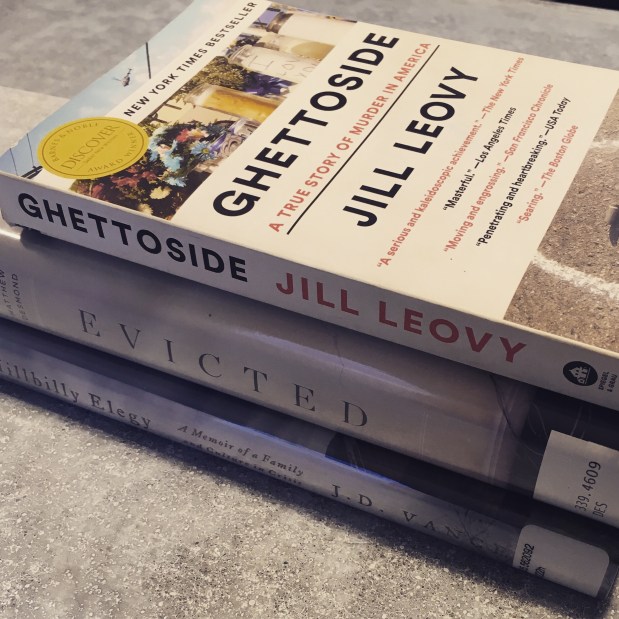
- Ghettoside: A True Story of Murder in America- Jill Leovy
- Evicted: Poverty and Profit in the American City- Matthew Desmond
- Hillbilly Elegy: A Memoir of a Family and Culture in Crisis- J.D. Vance
What are you reading?
Two Speed Recovery: Detroit and Beyond
The New York Times published a piece investigating the recovery of Detroit, outlining the two distinct worlds the city’s recovery has created and exacerbated. But this story isn’t exclusive to Detroit. As American cities bounce back from the recession, two very separate worlds are taking hold in cities all across the nation. Whether you’re in Washington, DC, San Francisco, or Columbus, Ohio it is clear that not everyone in our recovering cities are actually recovering.
We Need an Inclusive Economy
These are th e sort of things that make us proud to be a Benefit Corp.
“We need an inclusive economy. To create an inclusive economy requires that we prioritize, measure, and manage the diversity and inclusivenes of our businesses, our supply chains, our investments, and our B Corp community.
In short, we must lead on inclusion to be credible leaders of a global movement of people using business as a force for good.”
Currently on Our Shelves
Currently on our shelves and highly recommended:

- The New Jim Crow: Mass Incarceration in the Age of Colorblindness- Michelle Alexander
- Encyclical on Climate Change & Inequality: On Care for our Common Home- Pope Francis
- Root Shock: How Tearing up City Neighborhoods Hurts America and What We Can Do About It- Mindy Thompson Fullilove
What are you reading these days?
 Root + Branch